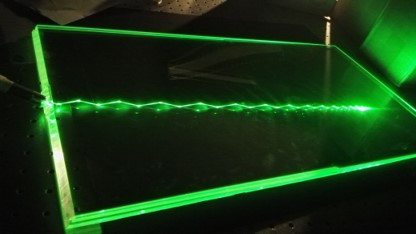
A good way of making optical systems slim is to fold them into slab light-guides. Particularly simple is the wedge light-guide that can be used to magnify the size of an image. Shine a video projector into the thick end of a correctly designed wedge, for example, and a magnified image will appear on the wedge surface. That is useful if you want to make a flat panel display that is also transparent.
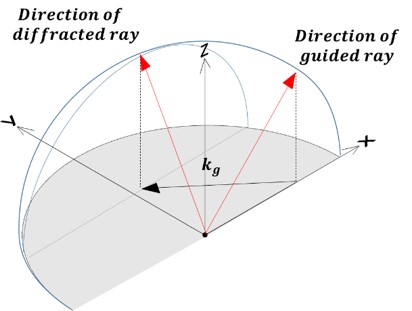
With virtual images, it is the pupil of the image that we want to expand rather than image size because tiny video projectors produce virtual images that can only be seen at one point. Pupil expansion is done by pointing the projector through the side of a slab waveguide laminated with a grating e.g. Microsoft Hololens. Design starts by summing the direction vectors of rays and gratings.
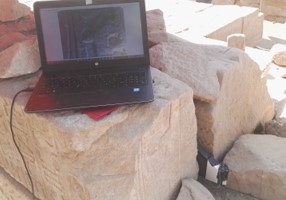
Optical systems are reversible in the sense that if I can see you, you can see me, so wedge light-guides work also as flat panel cameras. Recently, wedge cameras were slipped into the crevices in ancient walls to look at hieroglyphics engraved on hidden surfaces. Wedge cameras are also used in industrial inspection.
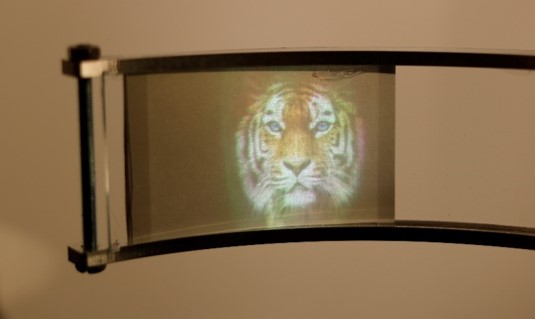
Wedge guides can be designed to be curved, useful if attempting augmented reality with extreme fields of view. Manufacture is easier than might be supposed because the exact curvature of the surface does not matter too much. It is how thickness changes with length that determines the path of each ray and Travoptics can help clients choose appropriate tolerances and surface smoothness.